PFAS Water Filters for Brisbane & Gold Coast
PFAS water filters are filtration systems selected specifically for reducing
certain per- and polyfluoroalkyl substances, commonly called PFAS or
"forever chemicals", in drinking water or the broader household water supply.
JR Gas & Water supplies and installs PFAS filtration systems throughout
Greater Brisbane, the Gold Coast, Logan, Ipswich, Redlands, Moreton Bay,
Scenic Rim and surrounding South East Queensland areas.
PFAS filtration can be approached in several ways. Some households mainly
want PFAS reduction at the kitchen drinking-water outlet, while others want
a point-of-entry system treating water before it is distributed throughout
the property. A combination of whole-house filtration and dedicated
reverse-osmosis drinking-water treatment can also be used where both treatment
levels are wanted.
The important part is product-specific performance. Not every carbon
cartridge, whole-house filter or reverse-osmosis system has been tested for
the same PFAS compounds or to the same reduction level.
JR Installer Verdict:
PFAS is one category where we would not choose a filter from generic marketing
claims. If PFAS reduction is the reason for buying the system, check the exact
filter, cartridge or RO system for verified PFAS performance.
What Are PFAS or "Forever Chemicals"?
PFAS stands for per- and polyfluoroalkyl substances. It describes a large
group of manufactured chemicals that have been used because of properties
such as resistance to heat, water, grease and stains.
The term "forever chemicals" is commonly used because many PFAS compounds
are highly persistent and can remain in the environment for long periods.
PFAS is not one single contaminant, and different PFAS compounds can behave
differently during water treatment.
PFOS
Perfluorooctane sulfonic acid is one PFAS compound specifically covered by
the Australian Drinking Water Guidelines.
PFOA
Perfluorooctanoic acid is another PFAS compound with a specific Australian
health-based drinking-water guideline value.
Other PFAS
PFHxS, PFBS, GenX chemicals and many other PFAS compounds form part of the
much broader PFAS family.
JR Installer Verdict:
"Removes PFAS" is too broad by itself. PFAS is a family of chemicals, so
performance should be checked against the compounds and test conditions
relevant to the actual product.
Australian PFAS Drinking Water Guidelines
Australia's National Health and Medical Research Council updated the
Australian Drinking Water Guidelines for PFAS in 2025. The guideline now
provides separate health-based values for PFOA, PFOS, PFHxS and PFBS.
| PFAS Compound |
Australian Guideline Value |
Equivalent |
| PFOS |
8 ng/L |
0.008 µg/L |
| PFOA |
200 ng/L |
0.2 µg/L |
| PFHxS |
30 ng/L |
0.03 µg/L |
| PFBS |
1000 ng/L |
1 µg/L |
| GenX Chemicals |
No Australian health-based guideline value currently derived |
Refer to current NHMRC guidance |
Reference:
These values are from the Australian Drinking Water Guidelines PFAS guidance
endorsed in 2025. Guidelines can be updated as evidence changes.
View current NHMRC PFAS guidance →
How Do You Know if PFAS Is in Your Water?
PFAS cannot be reliably identified from the appearance, taste or smell of
water. A normal TDS meter, hardness test or simple home water-quality
demonstration also does not tell you the concentration of individual PFAS
compounds.
Where confirming PFAS concentration is important, water needs appropriate
laboratory analysis specifically capable of testing for the relevant PFAS
compounds.
TDS Does Not Identify PFAS
A TDS meter measures electrical conductivity associated with dissolved ions.
It does not identify or quantify individual PFAS compounds.
Hardness Does Not Identify PFAS
Hardness testing measures mineral-related characteristics and should not be
used as evidence that PFAS is present or absent.
Laboratory Testing
Where a measured PFAS concentration is required, use an appropriate
laboratory test designed for PFAS analysis.
JR Installer Verdict:
Do not let anyone "demonstrate" PFAS using a TDS meter or generic water test.
If you need to know whether PFAS is present and at what concentration, use
proper laboratory testing.
What Water Filters Can Reduce PFAS?
Several water-treatment technologies can be used for PFAS reduction.
Performance depends on the PFAS compounds involved, filter media, capacity,
flow, contact time, system design and how long the treatment media has been
in service.
Activated Carbon Filtration
Suitable activated-carbon systems can reduce PFAS and are commonly used in
both whole-house and point-of-use filtration. Performance varies between
media types and PFAS compounds.
Reverse Osmosis
RO membrane systems are a strong point-of-use treatment option for households
wanting high-level PFAS reduction in dedicated drinking and cooking water.
Compare reverse osmosis systems →
Ion Exchange
Specialist ion-exchange media can be used in PFAS treatment applications.
Suitability depends on the individual system and treatment objective.
JR Installer Verdict:
The technology name alone is not enough. "Carbon", "RO" and "ion exchange"
describe broad treatment methods; the actual product still needs to be
appropriate for PFAS reduction.
PFAS Filter Certification & Verified Reduction Claims
Where PFAS reduction is the main reason for installing a water filter,
independent certification or verified performance data is one of the most
useful ways to compare products.
NSF identifies drinking-water treatment products with relevant PFAS reduction
claims under standards including NSF/ANSI 53 for drinking-water treatment
units and NSF/ANSI 58 for reverse-osmosis systems.
That does not mean every product certified to one of those standards
automatically has a PFAS claim. The certification and reduction claim need to
apply to the specific product being considered.
NSF/ANSI 53
Can apply to drinking-water filtration products carrying verified health-effect
reduction claims, including relevant PFAS claims where specifically certified.
NSF/ANSI 58
Applies to reverse-osmosis drinking-water systems and can include verified
PFAS reduction claims for qualifying products.
JR Installer Verdict:
When PFAS is the concern, compare the exact certification and contaminant
claim. Do not assume that a general "NSF certified" statement means the
product is specifically certified for PFAS reduction.
Whole House vs Drinking-Water PFAS Filtration
PFAS filtration can be installed at the incoming household supply or at a
dedicated drinking-water outlet. The two approaches treat very different
volumes of water.
| Feature |
Whole-House PFAS Filtration |
Drinking-Water PFAS Filtration |
| Installation point |
Incoming household water supply |
Kitchen / drinking-water outlet |
| Water volume |
High household flow |
Lower point-of-use flow |
| Water treated |
Multiple fixtures downstream |
Drinking and cooking water |
| Common treatment direction |
Suitable high-capacity PFAS filtration media |
PFAS-rated cartridge or reverse osmosis |
| Cartridge / media capacity |
Needs to handle large household volume |
Lower volume allows more specialised treatment |
| Best suited to |
Broader household filtration preference |
Focused drinking-water PFAS reduction |
JR Installer Verdict:
For PFAS concerns, drinking and cooking water is normally the first place to
consider specialised treatment. Whole-house filtration can then be added
where the homeowner wants PFAS-capable filtration across the broader water
supply.
Whole House PFAS Water Filters
Whole-house PFAS filtration is installed on the incoming supply so treated
water is distributed to multiple fixtures throughout the property.
Because whole-house systems treat significantly more water than a kitchen
filter, media capacity, contact time and household flow are especially
important. A cartridge that performs well at drinking-water flow is not
automatically appropriate at whole-house flow.
High-Flow PFAS Filtration
Whole-house systems need enough filtration capacity to support realistic
simultaneous household water demand while maintaining the required treatment
performance.
Compare whole-house water filters →
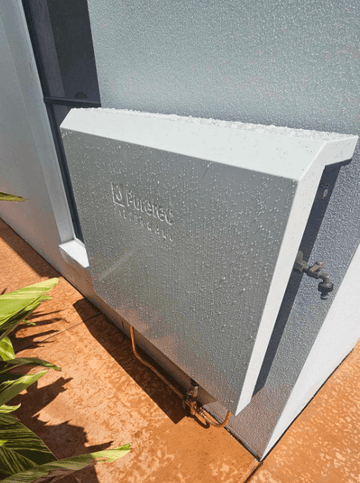
Covered & Enclosed PFAS Systems
Premium enclosed systems can combine PFAS-capable whole-house filtration with
a cleaner cabinet-style external installation.
Compare covered & enclosed filtration →
JR Installer Verdict:
For whole-house PFAS filtration, capacity is critical. A high-flow system
needs enough suitable treatment media to deal with the much greater volume of
water passing through it.
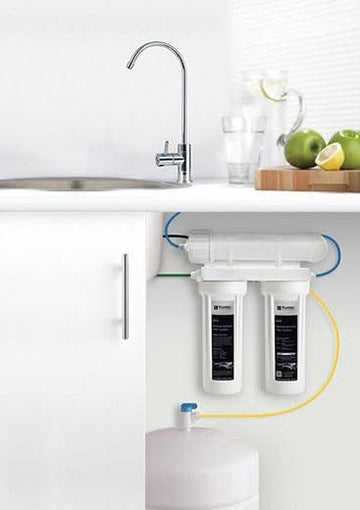
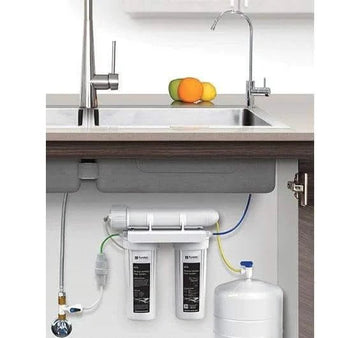
Under Sink PFAS Water Filters
Under-sink PFAS filtration concentrates treatment at the kitchen where water
is most commonly used for drinking and cooking. Because the flow and total
water volume are lower, point-of-use filtration can use more specialised
treatment without needing to process every litre entering the property.
PFAS-Rated Cartridge Filtration
Suitable under-sink carbon or specialist filtration can provide PFAS reduction
where the individual cartridge has appropriate verified performance.
Compare under-sink water filters →
Reverse Osmosis
RO is a stronger specialist option where the household wants broader
dissolved-contaminant reduction alongside PFAS treatment at the drinking-water
outlet.
Compare reverse osmosis →
Reverse Osmosis vs Carbon Filtration for PFAS
Both suitable activated-carbon systems and reverse osmosis can be used for
PFAS reduction, but they work differently and suit different applications.
| Feature |
Suitable Carbon Filtration |
Reverse Osmosis |
| Treatment method |
Adsorption onto suitable carbon media |
Membrane separation plus supporting filtration |
| Common application |
Under sink or whole house |
Primarily drinking water |
| Whole-house flow |
Can be designed for high flow |
Not normally used for standard residential whole-house flow |
| PFAS performance |
Depends on media, PFAS type, flow and capacity |
Depends on membrane and complete system performance |
| Reject water |
No RO-style concentrate stream |
Produces reject water |
| Maintenance |
Media / cartridge replacement |
Pre-filters, membrane and other service components |
| Best suited to |
Point-of-entry or simpler point-of-use treatment |
Higher-level dedicated drinking-water treatment |
JR Installer Verdict:
For a PFAS-focused drinking-water outlet, RO is one of the strongest
residential options to compare. For whole-house treatment, suitably verified
high-capacity filtration media is generally more practical.
Can Whole House & Reverse Osmosis PFAS Filtration Be Used Together?
Yes. A layered approach uses one system at the point of entry and another at
the kitchen drinking-water outlet.
Layer 1 – Whole House
A PFAS-capable whole-house system treats water before it is distributed
through the property and can also perform other whole-home filtration
functions depending on the selected cartridges.
Layer 2 – Kitchen RO
A reverse-osmosis system then provides a dedicated higher-treatment
drinking-water outlet for drinking, cooking, tea and coffee.
JR Installer Verdict:
For customers wanting both broader household filtration and stronger
drinking-water treatment, we prefer using the right technology at each point
rather than forcing one filter to do everything.
Does Boiling Water Remove PFAS?
No. Boiling should not be used as a PFAS treatment method. PFAS is not treated
in the same way as microorganisms that can be inactivated by heating water.
Where PFAS reduction is required, use an appropriate water-treatment system
with verified performance for the relevant PFAS compounds.
JR Installer Verdict:
Boiling is not filtration. If PFAS is the concern, use a treatment technology
designed and verified for PFAS reduction.
Why Different PFAS Can Be Harder to Filter
PFAS is a broad chemical family rather than one substance. Different PFAS
compounds can interact differently with activated carbon, ion-exchange media
and membrane systems.
This is one reason a generic claim such as "carbon removes PFAS" is not enough.
Performance can vary with the individual PFAS compound, media, water chemistry,
flow rate and how much water has already passed through the filter.
JR Installer Verdict:
PFAS performance can change as filter media loads over time. Initial
performance and long-term treatment capacity are both important when
comparing filtration systems.
Why PFAS Filter Capacity & Cartridge Changes Matter
PFAS treatment media has finite capacity. As water passes through the system,
the treatment media gradually becomes loaded and its ability to continue
adsorbing contaminants can reduce.
A PFAS-capable filter therefore needs to be serviced according to the
product's rated capacity and maintenance requirements rather than being left
in service indefinitely.
Water Volume
A household using more water can reach cartridge treatment capacity sooner
than a lower-use household.
PFAS Concentration
Incoming contaminant concentration can affect how much treatment capacity is
used over time.
Other Water Chemistry
Other substances in the water can interact with filtration media and influence
real-world performance.
JR Installer Verdict:
For PFAS filtration, cartridge replacement is part of the treatment strategy.
Once suitable media is exhausted, simply continuing to run water through the
same filter does not restore its capacity.
How to Choose a PFAS Water Filter
PFAS filtration should be selected around treatment evidence and the amount of
water being treated, not the number of stages or the appearance of the filter.
1. Decide Where You Want Treatment
Choose between dedicated drinking-water filtration, broader whole-house
filtration or a combination of both.
2. Check PFAS Performance
Look for product-specific test data or certification relevant to PFAS
reduction.
3. Check Flow Rate
A kitchen filter and a whole-house system operate at very different water
flows and need different equipment.
4. Check Rated Capacity
Treatment performance needs to be considered over the intended service life,
not only when the cartridge is brand new.
5. Check Replacement Availability
A PFAS filtration system needs replacement media or membranes that can be
readily sourced when servicing is due.
6. Compare Long-Term Cost
Include cartridge, membrane and servicing costs when comparing the real cost
of ownership.
PFAS Water Filter Installation Brisbane & Gold Coast
JR Gas & Water supplies and installs PFAS-focused drinking-water and
whole-house filtration throughout Brisbane, the Gold Coast and surrounding
South East Queensland areas.
1. Define the Treatment Goal
Confirm whether PFAS reduction is wanted mainly for drinking water, the whole
home or both.
2. Select Verified Filtration
Compare systems with suitable PFAS treatment performance rather than generic
filter claims.
3. Size the System
Match filtration capacity and flow to the amount of water the system needs
to treat.
4. Choose the Installation Position
Whole-house systems require suitable point-of-entry plumbing while drinking
water systems normally install beneath the kitchen sink.
5. Install & Connect
Install the filtration equipment, isolation, pipework and drinking-water
outlet or whole-house connection required by the selected system.
6. Flush, Test & Commission
Flush the filtration media as required, check plumbing connections and confirm
correct operation before completion.
How Much Does a PFAS Water Filter Cost?
PFAS filtration cost depends heavily on where the treatment is installed.
A dedicated kitchen PFAS filter treats a relatively small volume of water,
while a whole-house PFAS system needs substantially greater flow and media
capacity.
JR Gas & Water displays current PFAS filtration products and installed
pricing in the live range above so customers can compare actual systems rather
than relying on a generic price estimate.
What Changes the Installed Price?
- Whole-house versus drinking-water filtration.
- Filter technology.
- PFAS treatment capacity.
- Cartridge or media size.
- Household flow requirements.
- Reverse-osmosis equipment where selected.
- Open versus enclosed whole-house design.
- Existing pipework.
- Installation position.
- Kitchen tap requirements.
- Replacement cartridge or membrane cost.
- Additional plumbing or electrical requirements.
JR Installer Verdict:
For PFAS, compare treatment evidence and lifetime servicing cost before
comparing the cheapest purchase price. The cartridge or membrane doing the
actual treatment is the important part.
PFAS Filter Maintenance & Cartridge Replacement
PFAS filtration relies on treatment media or membranes that have finite
service lives. Replacement intervals vary with the individual system, water
use, incoming water conditions and manufacturer requirements.
Maintenance can include:
- Replacement of PFAS-capable carbon cartridges.
- Replacement of pre-filters.
- RO membrane servicing where fitted.
- Post-filter replacement where fitted.
- Inspection of filter housings and seals.
- Checking system flow and pressure.
- Flushing new filtration media.
- Recording service dates and cartridge changes.
Compare water filter replacement cartridges →
JR Installer Verdict:
A PFAS filter should not be treated as fit-and-forget equipment. The media
doing the contaminant reduction has a finite capacity and needs to be serviced
as part of the system.
What We Look for in a PFAS Water Filtration System
Actual PFAS Evidence
If PFAS is the treatment objective, we want product-specific evidence rather
than a broad claim that the filter "removes chemicals".
Correct Application
A strong drinking-water filter is not automatically suitable for whole-house
flow and a whole-house filter is not automatically the strongest kitchen
purification option.
Enough Treatment Capacity
Media volume and rated life matter because PFAS treatment performance needs
to continue beyond the first few litres of water.
Replacement Availability
The system needs cartridges, membranes or media that remain practical to
source over the long term.
Realistic Flow
Whole-house filtration needs to achieve useful household flow without
sacrificing the conditions required for the treatment media.
No Fear-Based Selling
PFAS is a serious technical water-quality issue. Product selection should be
based on testing, verified performance and the homeowner's actual treatment
goal rather than scare tactics.
Common PFAS Water Filtration Mistakes
Assuming Every Carbon Filter Removes PFAS
Carbon media varies significantly. PFAS performance should be confirmed for
the actual cartridge or system.
Assuming Every RO System Is Equal
Membranes, pre-filtration, production rates and verified reduction claims vary
between reverse-osmosis systems.
Using a TDS Meter to "Test" for PFAS
TDS does not identify individual PFAS compounds and cannot confirm whether a
PFAS filter is required.
Choosing by Stage Count
A five-stage system is not automatically better for PFAS than a correctly
verified one- or two-stage system.
Ignoring Cartridge Capacity
Initial reduction performance is not the only consideration. Treatment media
needs enough capacity for the intended service period.
Trying to Treat PFAS by Boiling
Boiling water is not an appropriate PFAS removal method. Use filtration
technology designed for PFAS reduction.
PFAS Water Filters Brisbane & Gold Coast
PFAS Water Filters Brisbane
JR Gas & Water supplies and installs PFAS-focused water filtration
throughout Greater Brisbane, Logan, Ipswich, Redlands, Moreton Bay, Scenic Rim
and surrounding areas.
Options include under-sink PFAS filtration, reverse osmosis and PFAS-capable
whole-house filtration depending on the treatment objective and property.
PFAS Water Filters Gold Coast
JR Gas & Water installs PFAS filtration throughout the Gold Coast,
including dedicated drinking-water systems and whole-house filtration.
We compare the treatment technology, verified PFAS performance, flow
requirements and future cartridge servicing before selecting the system.
PFAS Water Filter FAQs
What does PFAS stand for?
PFAS stands for per- and polyfluoroalkyl substances. It describes a large
family of manufactured chemicals rather than one individual contaminant.
Why are PFAS called forever chemicals?
The term is commonly used because many PFAS compounds are highly persistent
and break down very slowly in the environment.
Can a water filter remove PFAS?
Suitable filtration systems can significantly reduce certain PFAS compounds.
Common treatment technologies include appropriate activated carbon,
reverse osmosis and specialist ion-exchange media. Performance needs to be
checked against the individual product.
What is the best water filter for PFAS?
There is no single best filter for every application. Reverse osmosis is a
strong option for dedicated drinking-water treatment, while suitable
high-capacity filtration media can be used for whole-house PFAS treatment.
Product-specific verified performance is the key consideration.
Does reverse osmosis reduce PFAS?
Suitable reverse-osmosis systems can significantly reduce PFAS and are one
of the strongest residential options for dedicated drinking-water treatment.
Check the exact model's tested or certified PFAS performance.
Does activated carbon reduce PFAS?
Suitable activated-carbon media can reduce PFAS, but performance varies with
the carbon, PFAS compound, contact time, water chemistry, flow and cartridge
capacity. Do not assume every carbon filter provides equivalent PFAS
reduction.
Does boiling water remove PFAS?
No. Boiling should not be used as a PFAS treatment method. Where PFAS
reduction is required, use a filtration or treatment system designed and
verified for that purpose.
Can a TDS meter detect PFAS?
No. A TDS meter measures conductivity associated with dissolved ions and does
not identify individual PFAS compounds. PFAS concentration requires suitable
laboratory analysis.
How do I test my water for PFAS?
Where confirming PFAS concentration is important, use an appropriate
laboratory test specifically capable of analysing the relevant PFAS compounds.
Generic home water tests should not be treated as a PFAS test.
What are Australia's PFAS drinking-water guideline values?
The Australian Drinking Water Guidelines updated in 2025 specify
health-based values of 8 ng/L for PFOS, 200 ng/L for PFOA, 30 ng/L for PFHxS
and 1000 ng/L for PFBS. Always refer to the current NHMRC guidelines because
guidance can be updated.
Do I need a whole-house PFAS filter?
Not necessarily. Some households mainly want PFAS reduction in drinking and
cooking water and choose an under-sink system. Others prefer broader
point-of-entry filtration. The right approach depends on the treatment goal,
water use and budget.
Can I use whole-house filtration and reverse osmosis together?
Yes. A whole-house PFAS-capable filter can treat the incoming household
supply while a separate RO system provides specialised treatment at the
kitchen drinking-water outlet.
What certification should I look for on a PFAS filter?
Look for product-specific independent testing or certification that includes
the relevant PFAS reduction claim. NSF/ANSI 53 and NSF/ANSI 58 are examples
of standards under which relevant PFAS reduction claims may be certified.
How often should a PFAS filter be changed?
There is no universal replacement interval. Service life depends on the
specific cartridge or membrane, rated treatment capacity, water use,
incoming conditions and manufacturer requirements.
Does a PFAS filter also remove chlorine?
Some PFAS-capable carbon systems also reduce chlorine, taste and odour, but
the treatment performance depends on the individual cartridge. Check the
product specifications rather than assuming every PFAS filter has identical
additional capabilities.
Do you install PFAS water filters in Brisbane and Gold Coast?
Yes. JR Gas & Water supplies and installs PFAS-focused whole-house,
under-sink and reverse-osmosis filtration throughout Greater Brisbane,
the Gold Coast, Logan, Ipswich, Redlands, Moreton Bay, Scenic Rim and
surrounding South East Queensland areas.
Compare PFAS Water Filtration Options
PFAS treatment can be applied at the drinking-water outlet, across the whole
home or as a layered combination. Compare the related filtration categories
below.
Choose the Right PFAS Water Filter
Compare PFAS water filtration systems with current products and installed
pricing above. If you are unsure whether you need an under-sink PFAS filter,
reverse osmosis, whole-house filtration or a combination of systems, book an
onsite quote inspection and we can review the water supply, plumbing, flow
requirements and filtration options before you choose.